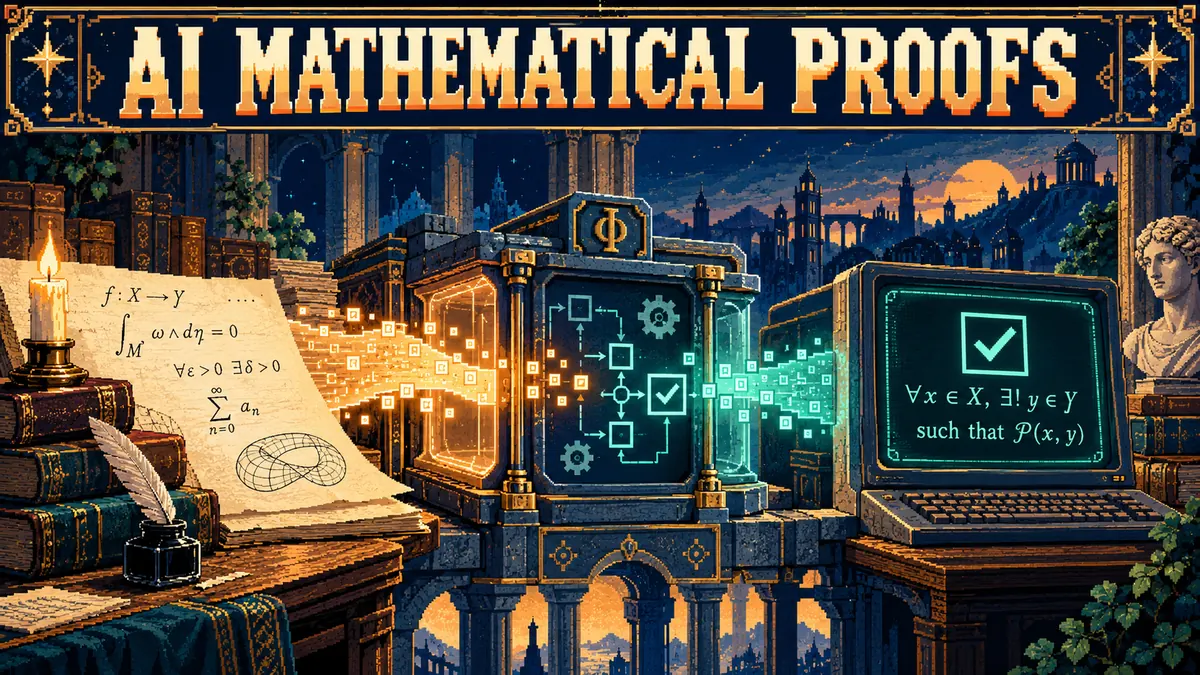
A computer-checked proof is the most interesting part of a new AI math result, and also the part people flatten into the wrong claim. Verification can establish a theorem in a formal system. It does not automatically tell you who discovered the idea or whether the surrounding story is correct.
Separate the result from the announcement
OpenAI's October 6, 2026 release shares manuscripts and Lean formalizations for mathematical results proposed with the help of an internal model. On October 15, the company added a follow-up about supporting mathematicians as they assess and build on the work. That is more substantial than a capability teaser because readers can inspect artifacts.
But a company statement is not the same thing as community validation. A manuscript can contain a valuable argument and still need expert review. A formal proof can establish that the encoded proposition follows from the encoded premises in Lean's trusted foundation. That does not prove the formal statement matches every intended claim in the prose, that the human authors identified all assumptions, or that the result is significant in the broader field.
The strongest story is precisely this separation: language models may help propose an argument, while formalization makes one portion of the verification problem explicit and mechanically checkable. The new part is not that mathematics suddenly needs no people. It is that a tool can make some hard checking more tractable.
What a Lean proof can and cannot establish
Lean represents definitions, assumptions and theorems in a formal language. Its kernel checks proof terms against those definitions. If the proof type-checks, the formal conclusion follows from the formal premises under the system's foundations. That is a remarkably strong guarantee about the encoded derivation.
The word 'encoded' matters. Formalizing a statement takes choices. Are the definitions equivalent to the informal mathematical objects? Were side conditions preserved? Does the statement say what the paper says it says? The kernel cannot catch a mistaken translation of the human goal into a different proposition. This is why experts still inspect the formulation and the significance of the result.
A good proof repository helps by making assumptions and dependencies visible. Reproduction matters too: can a clean checkout compile the project with stated versions? Are there hidden axioms or shortcuts? A trusted proof assistant greatly narrows one type of error, but it does not dissolve every other kind.
| Question | What a checked proof supports | What still needs judgement |
|---|---|---|
| Does the derivation follow? | Lean kernel accepted the formal proof | Whether the definitions match the intended math |
| Is the code reproducible? | The project compiles with the documented setup | Whether dependencies or assumptions are appropriate |
| Is the result new? | A formal proposition has a proof | How it relates to existing mathematical literature |
| Did the model invent it? | The report attributes work to a model-assisted process | Who noticed the right direction and shaped the formalization |
Mathematical discovery includes more than getting a proof
A research result involves choosing a worthwhile problem, finding a promising route, deciding what counts as a useful explanation, making definitions, correcting failed ideas and connecting the conclusion to what people already know. Proof formalization addresses an important part of that chain. It does not yet measure every part of it.
People also decide which results merit attention and whether a solution opens a new avenue. A corpus of machine-generated proofs can contain genuine advances and irrelevant formal exercises at the same time. The number of manuscripts is not a measure of mathematical insight. A count is useful for planning review effort, not a substitute for expert assessment.
The most honest and interesting way to read the October release is to follow a claim through artifacts. Which statement is formalized? What assumptions does it use? Who has independently checked it? What changed after the community read it? A verified proof is strong evidence about a derivation. Its place in mathematics is a wider question.
What evidence would change the conversation?
Independent mathematicians commenting on specific results, reproducible Lean projects, and papers that explain how verification proceeded would make the story clearer. So would transparent attribution: what the model proposed, which changes a researcher made, where the human found an error, and what was ultimately checked. The development process is itself research data.
For students, there is a useful learning pattern here. Start from a theorem, read the human explanation, then inspect the formal statement and proof. Notice where the informal and formal versions meet. Even if the system did not create the mathematical insight you expected, the artifacts can teach you how a proof is represented and checked.
This deserves curiosity and criticism at the same time. If the result survives expert scrutiny, that will matter more than a dramatic launch line. If it does not, the formalization may still show something useful about how AI systems participate in formal mathematics. Either way, we should argue about the proof people can inspect, not the future we imagine from a headline.
FOLLOW THE EVIDENCE
Sources & further reading
Process note: AI tools assisted with research and drafting. Sources are linked so you can inspect the evidence. Unless an essay says otherwise, it does not claim hands-on testing or independent reproduction.