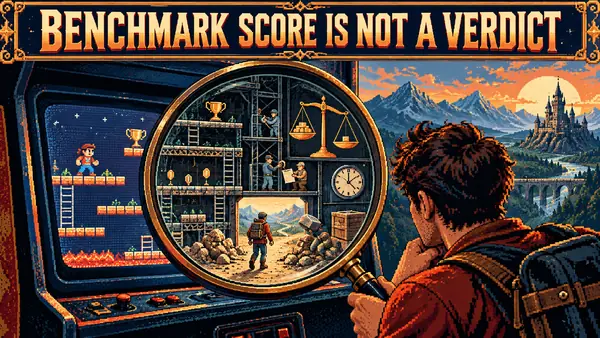
You do not have to understand every equation on the first pass. Start by finding out what question the paper actually answers and what evidence it uses.
Use three passes
First pass: title, abstract, introduction, section headings and conclusion. Write the problem in one sentence and name the authors' main claim. If you cannot state what changed, you may not need to read the full paper yet.
Second pass: methodology, data, evaluation and figures. Find the baseline, size and source of the dataset, metric, model version, training or inference setup, and the hardest limitation. Do not treat an abstract number as a complete result.
Third pass: read technical sections needed to check the claim. Follow definitions and assumptions. Recompute a small example or inspect code if the paper's central result depends on implementation details. Read equations with a question in mind rather than decoding every symbol at once.
How to interrogate a result table
Identify each row and column before scanning for bold numbers. Does the table compare the intended systems on the same test? Does it include an ablation that isolates the proposed idea? Is the reported average weighted over tasks or simply the average score? Are there error bars or repeated runs?
A table can establish a comparative improvement under a setup. It cannot automatically show that the method will generalize to every model, language or task. Look at individual tasks. A high average can hide one severe regression, and one eye-catching best result may be a narrow win against an old baseline.
| Question | Where to look | What a useful answer includes |
|---|---|---|
| What changed? | Method and ablations | An isolated design difference |
| What was tested? | Dataset and benchmark section | Source, size, splits and exclusions |
| Compared with what? | Baseline table | Strong and matching alternatives |
| How certain? | Variance, error bars, runs | Variation and sample size |
| What breaks? | Limitations and appendix | Known failure types and scope |
Follow the artifact and the source
If code, prompts, data or supplementary materials are linked, look at them. Reproducing a result may require expensive compute or missing data, but a small implementation test can still catch a mistaken reading. Check the revision history and publication status. A preprint is a public research draft, not the same as peer-reviewed acceptance.
Trace important claims to the original paper or artifact. An article about a benchmark might simplify the setup or use an outdated model score. When you share the result, link the original source and describe your interpretation as an interpretation.
Keep notes that help your next experiment
Use four headings: claim, evidence, limitation, next test. Under claim, write the strongest conclusion the paper supports. Under evidence, note the exact measurement and conditions. Under limitation, identify missing evidence or boundary cases. Under next test, record what you might try in your own problem.
You will remember papers better if you do something with them. Reproduce a small plot, compare one baseline or explain the work to a peer without looking at the abstract. If you cannot tell them what the method adds, reread the method section rather than repeating the paper's title.
A research paper is an argument supported by artifacts. Your job as a reader is to see whether the evidence carries the weight of the claim.
FOLLOW THE EVIDENCE
Sources & further reading
Process note: AI tools assisted with research and drafting. Sources are linked so you can inspect the evidence. Unless an essay says otherwise, it does not claim hands-on testing or independent reproduction.