The weirdest thing about AI slop on LinkedIn is that it can be perfectly grammatical and still leave you feeling like you read absolutely nothing. That gap between polished and useful is the whole problem.
Slop is about effort, not the tool
Calling every AI-assisted sentence slop is lazy. A person can use a language model to organize messy notes, clarify an explanation, or help a non-native speaker write more comfortably. That can make communication better. A carefully edited AI-assisted article can contain more thought than a rushed human one.
The useful distinction is whether the author contributes judgement that changes the result. Does the post contain a concrete observation, evidence, tradeoff, or decision the reader could use? Could the writer defend the central claim if the fluent draft disappeared? If the answer is no, we are looking at text that simulates the shape of thinking without doing much of it.
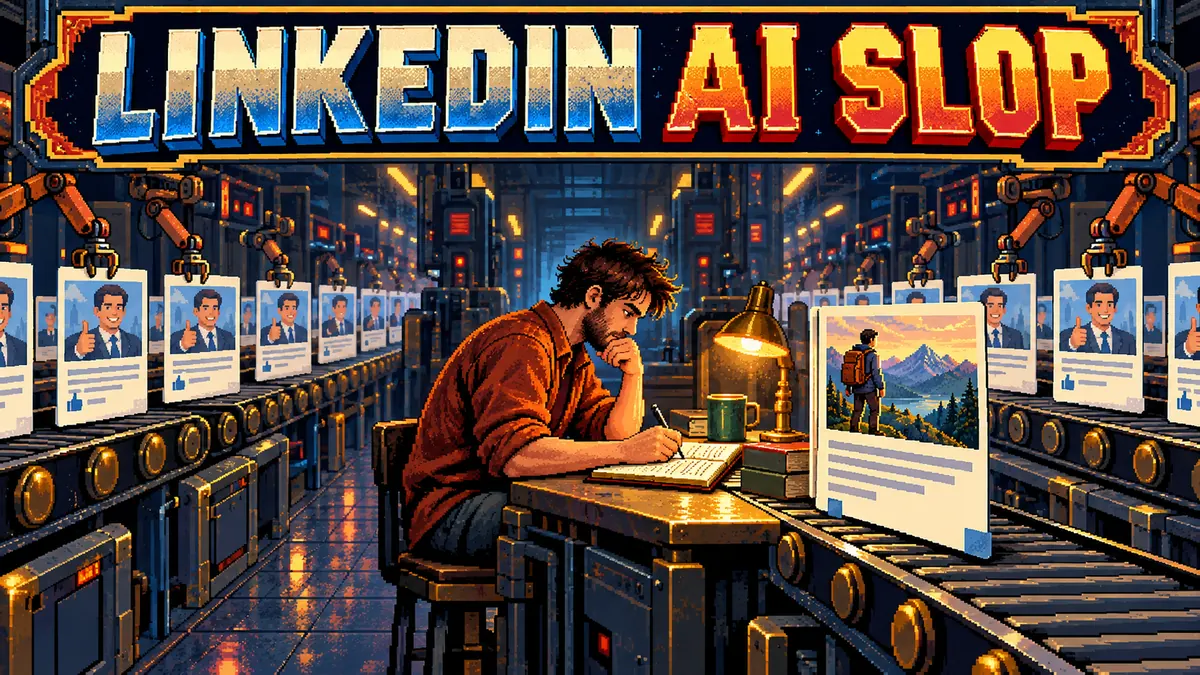
There is a familiar LinkedIn rhythm: big claim, line breaks engineered for scrolling, a numbered list of easy truths, and a closing question pretending the whole thing happened to you. AI did not invent this voice. It made producing it nearly free. The problem is the production economics: a shape that already performed well can now be made at a volume one person could not previously sustain.
The feed rewards a signal, not a mind
A feed sees a sequence of actions: someone stopped, expanded, reacted, commented, or moved on. It cannot inspect the sincerity of an insight. Platforms describe ranking in terms of signals and relevance, and those signals are imperfect proxies for whether a reader actually learned something. A sharp confession or an incendiary claim may earn activity even when the argument underneath is weak.
That creates a miserable game for people who want to write carefully. A nuanced post takes longer to make, often asks the reader to hold two ideas at once, and may be harder to compress into a clean rule. A generic claim is cheap to produce and easy to recognize. If creators copy the shape of whatever seems to work, the feed gets more uniform and every real observation has to fight through it.
This is not proof that one ranking feature caused the problem. LinkedIn's exact system changes and no public description captures every decision. But the incentive loop is visible enough: creators optimize the signals they can see, and everyone else inherits the texture of that optimization.
| What the reader sees | What it could be signaling | What we still do not know |
|---|---|---|
| A polished post | Strong writing, or fast template production | How much real thought went into it |
| Lots of comments | Relevance, controversy, or reciprocal commenting | Whether anyone changed their mind |
| Personal storytelling | First-hand insight, or a manufactured anecdote | What the author actually experienced |
What brain rot feels like in practice
Brain rot sounds unserious until you notice what repeated low-value content trains you to do. You start skimming for emotional cues instead of following an idea. You mistake a confident opening for an argument. You click, scroll, and remember the format better than the point.
The harm is not that one LinkedIn post permanently damages anyone's brain. That would be a dramatic claim without evidence. The smaller, more believable cost is attention. Every near-empty post asks for a little time and gives very little back. A stream of them can make professional learning feel like checking a feed for status updates rather than encountering people doing work.
And there is a social cost too. If every post reads like a lesson, people stop sharing unfinished questions. They hide uncertainty behind a confident takeaway because vulnerability seems risky and a neat story is easier to reward. That is how a network meant for people to show their work begins looking like a factory for polished conclusions.
A better workflow for AI-assisted posts
Start with material a language model cannot conjure honestly on your behalf: a real decision, a surprising result you actually observed, a failed attempt you can describe, or a question you are still working through. Write that down in plain language before asking for help.
Then use AI for a bounded job. Ask for a clearer outline, missing objections, a list of claims that need sources, or help finding where a reader might get lost. Keep one human draft. Check the references. Remove any statement that sounds like a personal experience you never supplied. Read the final thing out loud. If it would be odd to say in a conversation, rewrite it.
A practical last check is to delete the opening line and see if the body still says anything specific. Then delete the last paragraph. If nothing important disappears, the piece may be mostly hook and moral. That is a reasonable signal to stop polishing and find a more useful observation.
The point is not to prove you never use a tool. The point is to make the post carry your selection of what matters, rather than the model's most statistically familiar version of a LinkedIn essay.
- Name the concrete thing you saw, built, tested, or are uncertain about.
- Ask AI for one task at a time, such as structure or counterarguments.
- Verify every concrete claim and personal detail before publishing.
- Keep the awkward specific detail if it makes the account real.
- Cut generic advice that could belong to anyone in any industry.
FOLLOW THE EVIDENCE
Sources & further reading
Process note: AI tools assisted with research and drafting. Sources are linked so you can inspect the evidence. Unless an essay says otherwise, it does not claim hands-on testing or independent reproduction.