A speech model that runs locally in seconds is a different kind of release from another leaderboard winner. Phonon-2 makes the hardware and deployment question feel concrete.
Small does not have to mean toy
Fermion Research released Phonon-2 in September 2026 as an open English speech recognition model. Its model page lists a 164 MB download, an average 5.21 percent word error rate across seven English test sets on the Open ASR Leaderboard, and 606 times real time on the Neural Engine of an M5 MacBook Air. The same page says models that score better on that seven-set average are at least 5.8 times its size.
The interesting engineering choice is a compact encoder using learned quantization levels, with the team reporting roughly 2.1 bits per stored weight. The project says this lets the small file retain accuracy comparable to its 2.5 GB full-precision teacher on average, while beating the teacher on meeting and parliamentary speech in the evaluated sets.
That is a strong direction: local speech recognition gets practical when a device can run it quickly, privately, and without a GPU tied up by inference. But each number has a scope. The seven sets are English. An average is not a guarantee for one accent, microphone, name or noisy room. The size claim is about download and stored weights, not necessarily peak memory during every runtime.
Realtime factor is impressive and easy to misunderstand
A 606-times realtime figure means the system processed audio faster than it was recorded under the stated machine and runtime configuration. Fermion gives the example that an hour of audio becomes text in about six seconds on the Neural Engine. That is a throughput claim for that setup. It does not mean the first word appears six seconds after a person starts speaking, and it does not mean every computer achieves the same speed.
The changelog is useful here because it shows the product work around the model. Core ML runs on Apple's Neural Engine. Other releases describe MLX on Apple silicon, CPU tiers across processor families, CUDA containers, startup speed and timestamp support. The same weights meet different runtimes and hardware paths. That is why users should care about the exact engine rather than quote one peak number as universal.
For live dictation, time-to-first-text and key-up latency matter more than a giant batch's throughput. For transcribing an archive, throughput and memory matter. For a video editor, word timestamps and sentence segments may be the difference between a demo and something usable. Latency is part of the task definition.
The 5.21 percent score is one window into quality
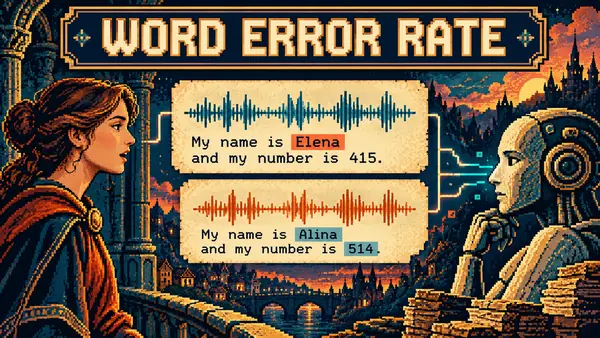
Word error rate counts substitutions, insertions and deletions relative to a reference, divided by the number of reference words. It gives a consistent summary of transcript mismatch. It treats errors differently from many users, though. Swapping a filler word might be harmless. Changing 'fifteen' to 'fifty' in a maintenance instruction is not. A misspelled product name can ruin a customer record even if the overall transcript barely changes.
The model page reports a seven-set average. Look up the individual sets and their recording conditions before applying the figure to your own use. Are the speakers conversational, scripted, remote, or amplified? Is the reference text normalized for punctuation and capitalization? Are set sizes balanced equally? The average answers a question chosen by an evaluation, not every deployment question a user might have.
For a fair local check, take permitted recordings representative of your workload, make accurate reference transcripts, and report the overall WER plus categories of errors that would matter. Never feed private audio into an external service without authority. For names and domain vocabulary, evaluate both the default model and a supported hotword setup.
| Metric | What it tells you | What you still need |
|---|---|---|
| Word error rate | Overall transcript edit rate | Impact-weighted error examples |
| Realtime factor | Audio duration processed per unit time | Hardware, runtime, startup and latency |
| Download size | How large the model package is | Peak memory and install requirements |
| Word timestamps | Where each recognised token occurs | Alignment accuracy on long or noisy clips |
| Language coverage | Which speech varieties are supported | Accent, code switching and vocabulary results |
Open weights and local inference have real value
Fermion releases Phonon-2 weights under Creative Commons Attribution 4.0. Its model page says that permits commercial use, modification and redistribution with attribution, and notes that the weights inherit that license from the Parakeet TDT 0.6B v3 base. The command-line software is described separately as Apache 2.0. Check the current notices before redistributing a product. Open weights, code and license terms are not one undifferentiated thing.
On-device inference can reduce how much sensitive audio leaves a user's machine. That is valuable for meeting notes, personal dictation, or offline environments. 'Local' still does not cover your whole application automatically. A cloud backup, updater, analytics service, crash reporter or external model can receive data through another path. Threat modelling the product matters as much as locating the weights.
The exciting part is that a 164 MB English model can be useful enough to ship in a real dictation workflow. The responsible part is keeping the next sentence specific: useful on which speakers, on which hardware, under which license, for which kinds of audio? That is a far better conversation than pretending a single score settled speech recognition.
FOLLOW THE EVIDENCE
Sources & further reading
Process note: AI tools assisted with research and drafting. Sources are linked so you can inspect the evidence. Unless an essay says otherwise, it does not claim hands-on testing or independent reproduction.